
A ground-breaking explanation of the mechanism by which early-stage melanomas become at risk of spreading has just been published in the British Journal of Dermatology[1].
The team at Newcastle University, led by Professor Penny Lovat, in association with AMLo Biosciences have now described the process by which the secretion of TGFβ2 by a primary melanoma causes the reduction, or downregulation, of the proteins AMBRA1 and loricrin in the epidermis overlying the tumour. The growth factor TGFβ2 also causes the loss of claudin-1 leading to loss of the integrity of the skin thereby facilitating tumour ulceration.
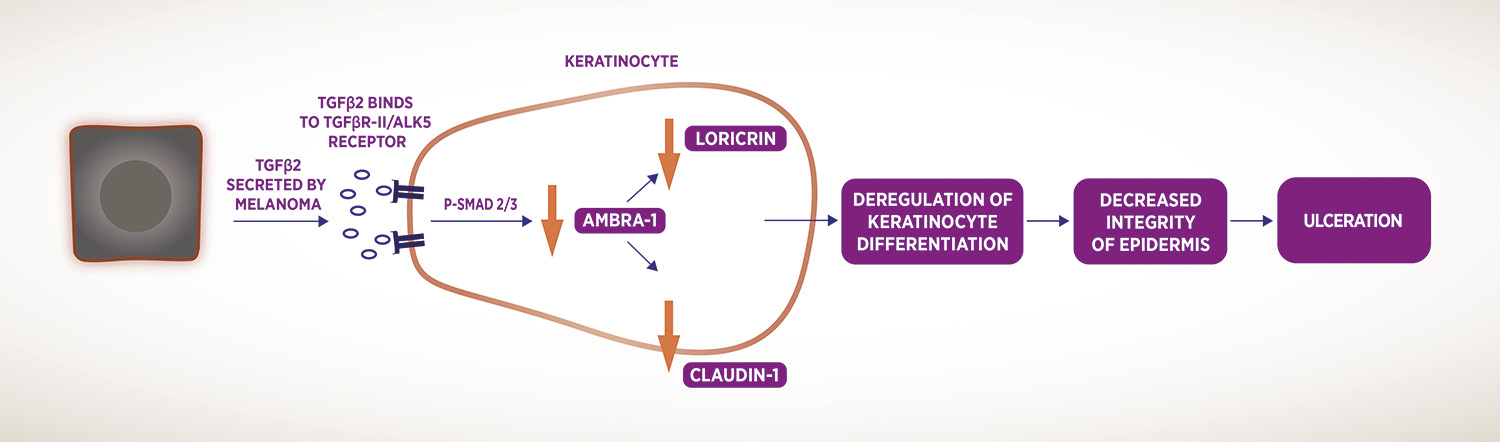
AMBRA1 and loricrin evidence
AMBRA1 and loricrin are found in the epidermis. In normal skin these proteins are clearly expressed but original research found that they are absent or reduced in early-stage cutaneous melanomas that are at risk of spreading[2].
A confirmatory study comprising over 400 stage I and II melanoma samples from USA and Australia, followed up for over seven years, was been published and demonstrates high accuracy at detecting genuinely low-risk tumours[3].
Melanoma management
Melanoma incidence is increasing. Every year around 16,000 people are diagnosed with Stage I or II melanoma. All of these are managed as if at-risk on an intensive follow-up regimen. However, fewer than 20% of these will metastasise. By detecting the presence or absence of AMBRA1 and loricrin in the skin over a tumour, genuinely low-risk patients can be identified and potentially have a less intensive follow-up regimen.
A UKAS-accredited referral service employing AMBRA1 and loricrin antibodies has now been set up in Newcastle. Clinicians can send melanoma biopsies to a specialist laboratory for staining and analysis to stratify tumour metastatic risk. Click here for information on how to access the referral service.
- Cosgarea I, et al. https://onlinelibrary.wiley.com/doi/10.1111/bjd.20889
- Ellis R, et al. Br J Dermatol. 2020;182(1):156–65
- Ewen T et al. Cell Pigment and Melanoma Research. [In press]